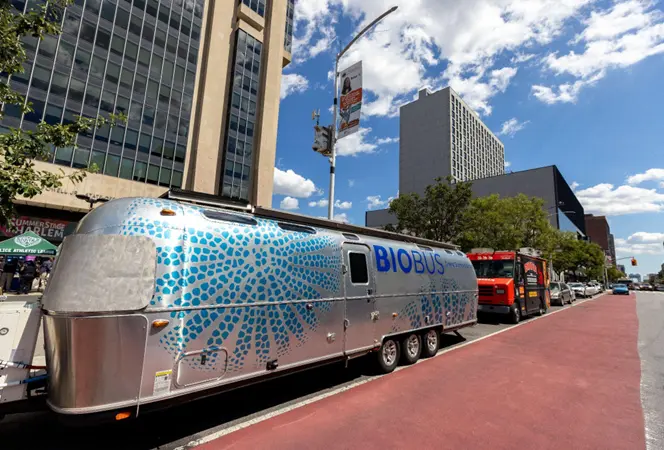
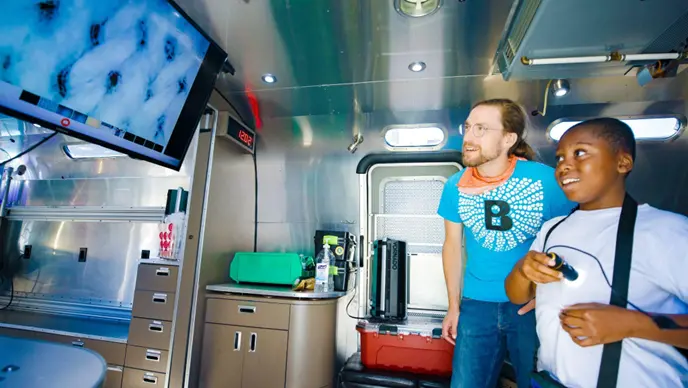
Since 2008, BioBus has helped students from elementary school through college discover, explore, and pursue science. Reaching 430,000 students globally to date, BioBus offers hands-on science labs aboard mobile labs equipped with Evident microscopes as well as after school, weekend, and summer programs and internships. The initiative specifically focuses on students excluded from the scientific community due to factors such as race, gender, economic status, and physical access, with an emphasis on the New York City and Boston areas.
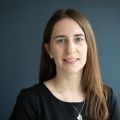
As part of Evident’s ongoing collaboration with BioBus, we interviewed two BioBus Junior Scientists, Sulaf and Josh, on their findings from studying the reproductive habits of Caenorhabditis elegans (C. elegans) under the microscope and how Evident microscopes played a valuable role in their research.
Q: Can you tell us what your project is about? What’s special about C. elegans?
Sulaf: Our project focused on the microscopic nematode (worm) species C. elegans, and how their fertility/ability to lay eggs is impacted by exposure to a high sugar diet. While we put a lot of focus into studying the fertility rates of our worms, we used this data more as a tool to see how their bodies reacted to the high sugar diet. C. elegans share many genes with a variety of species, including humans, which is why they are so commonly studied, and why we chose them for our project.
Josh: Research on how nutrition and diet affect the human system can be done very well by studying C. elegans. We chose to study this because food disparity and overconsumption of sugar is a growing problem in America. It’s important to study the sugar effects of C. elegans fertility, because we can then observe the lifelong effects of high sugar intake on reproduction in a short period of time.
Q: What do you see when you look at C. elegans under the microscope?
Josh: When you look at C. elegans under the microscope, you see a grouping of very small, transparent worms that are at different stages of their lives.
Sulaf: Honestly, when you see them up close, I think they’re adorable! They look like short, skinny roundworms (though the fully-grown worms get a bit chunkier), but entirely transparent and sometimes a very light blue. When they move, they kind of shimmy across their surroundings, and it’s very cute.
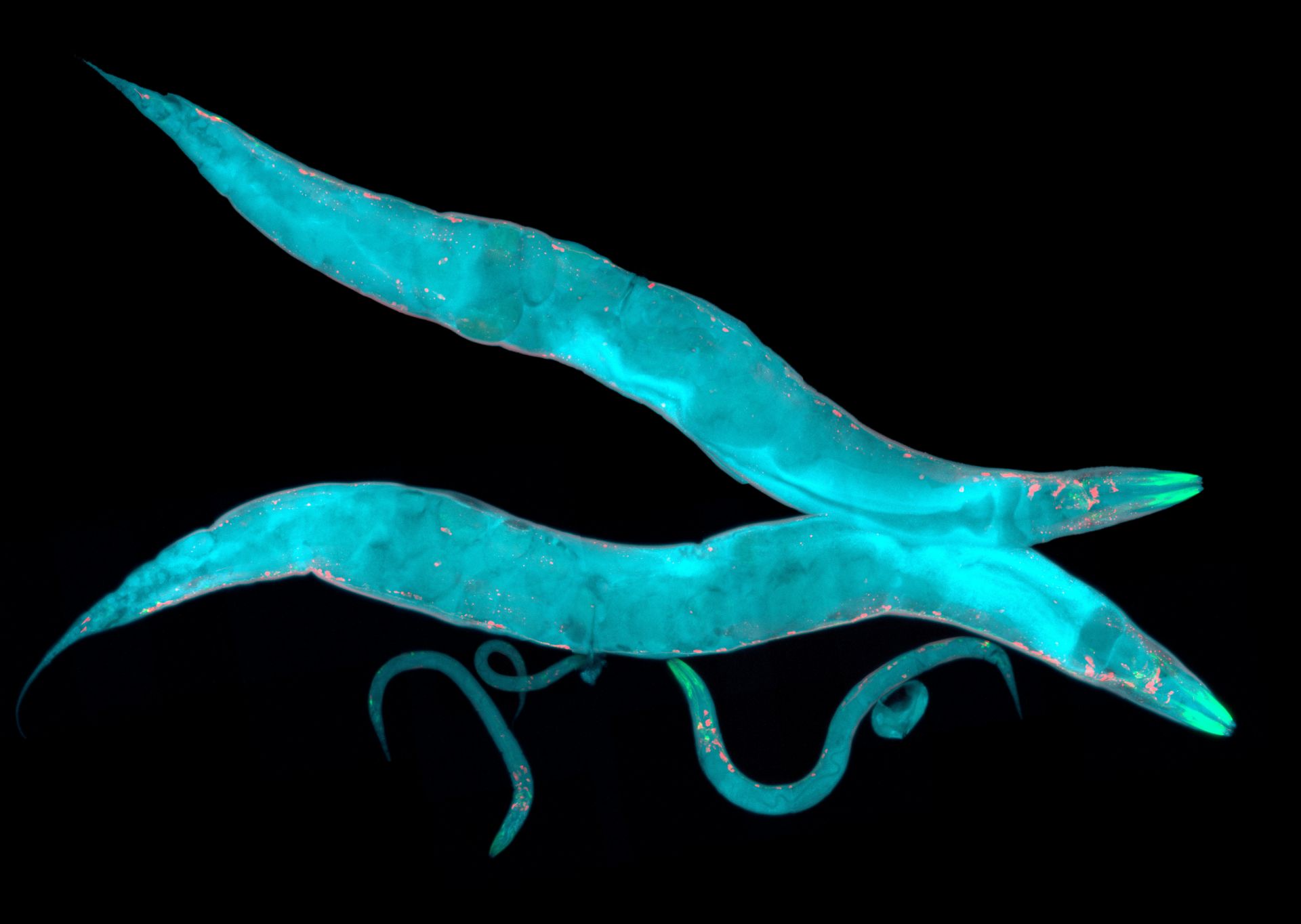
C. elegans under the microscope
Q: What makes Evident microscopes a valuable tool in your research with C. elegans?
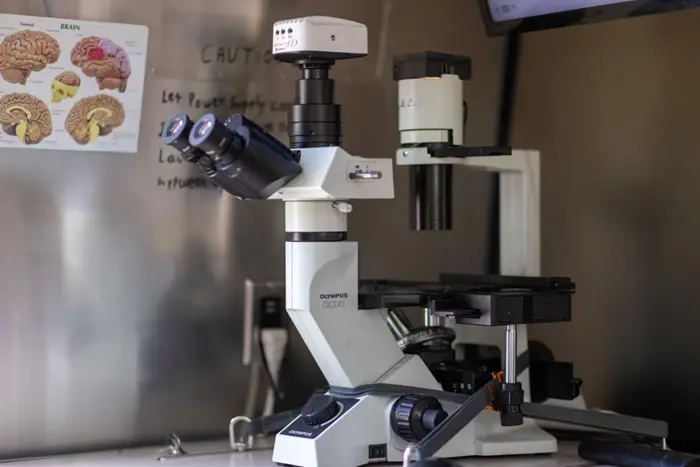
Sulaf: When working with a species like C. elegans, good stereo microscopes are absolutely vital. The only way to transfer the worms from plate to plate or even just observe them is under a microscope, so on the rare occasion that we couldn’t have access to a microscope (or we had to use one that wasn’t able to zoom in enough), we were pretty much done for the day. If not for the tools we were able to have access to through Biobus and Evident, conducting our experiments would have been significantly slower and more difficult.
Josh: Evident microscopes allowed us to clearly observe and count the tiny eggs laid by the worms, which is essential for measuring fertility.
Q: What types of techniques do you use to study C. elegans under a microscope?
Josh: We examined agar plates and counted eggs within a defined area after incubation to view C. elegans under a microscope. To prevent agitating worms, we handled plates gently, adjusting focus slowly, and employing good lighting. This enabled us to see the long-term effect of sugar levels on fertility.
Sulaf: The main technique we had to learn when studying C. elegans under a microscope was how to recognize worms at different life stages, as well as learning how to spot worm eggs. Like all other creatures, C. elegans go through several developmental stages as they go from a larva to an adult, and not all of those stages lay eggs. Since we were counting how many eggs were laid in our plates as a way to gauge their fertility, and thus how comfortable the worms were with their new diet, accidentally including a pre-egg-laying worm in our experiment would muddy the numbers. We also had to learn how to quickly spot worm eggs, which is much harder than it sounds given how small they are and how easily they’d blend in with the rest of our experimental plates.
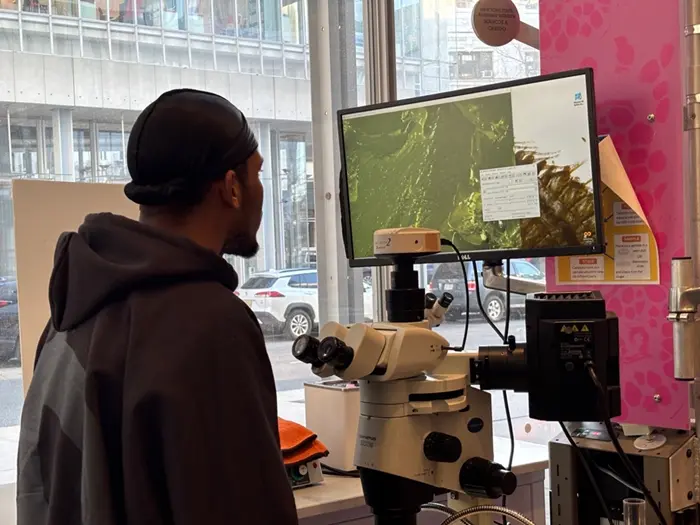
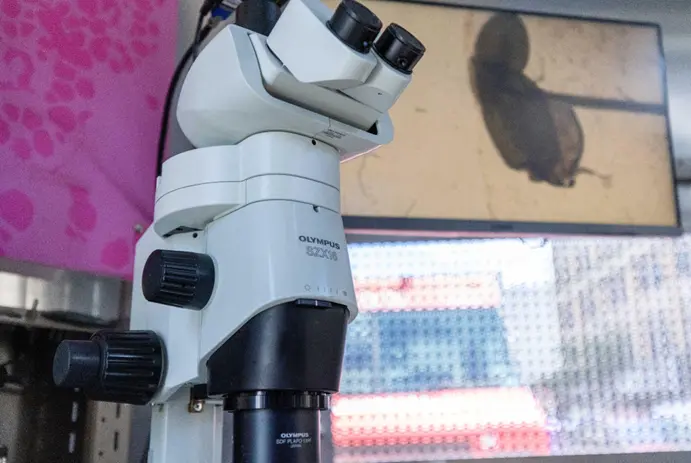
Josh using an Evident SZX16 stereo microscope
Q: What was the trickiest part of learning to handle such small organisms?
Sulaf: In my opinion, the trickiest part was getting the hang of worm picking, or transferring a worm to or from an experimental plate using some kind of pick dipped in E. coli. It’s an incredibly delicate job, often requiring the use of a specially made, incredibly thin metal pick (on occasion, a lab will use an eyelash for extra precision), and done entirely under a microscope. You can also only transfer one worm at a time, making it very time consuming.
Josh: Understanding how gentle you have to be with the organism, as well as learning to transport them without contaminating them and destroying the plate.
Q: How does your project help us understand more about how animals or even people can be affected by sugar?
Josh: Since C. elegans share many genes with humans, we can look at the observations we made on the changes in egg laying and then relate that back to how high sugar might affect animals and humans.
Sulaf: A lot of the discoveries that you can make from studying C. elegans in the ways we did come from inference. Both of us were very interested in nutritional science, and specifically how food disparity and the growing problem of food deserts across the country cause millions of Americans to exclusively consume a high sugar diet, since they just don’t have access to anything else. Since we obviously had no way to study actual humans for our experiment, C. elegans was our next best choice, especially since their short lifecycles (about 2-3 weeks) meant that we could more easily study the effect of this new diet over a lifetime. Granted, making these inferences requires a lot of data, which means our study alone may not have enough information to draw these conclusions, but I do believe it’s very possible.
Q: What’s something you didn’t know before you started this project, but now you understand?
Sulaf: Something I definitely understand better after this project is the huge margin for error that comes with taking care of insects, even microscopic ones. While I haven’t had much experience with using live subjects for research projects, I always assumed that mammals were the high-maintenance ones. Oh, how wrong I was, especially when it came to C. elegans! Those little worms were constantly getting infected, needed incredibly frequent maintenance, and would die at the drop of a hat.
Josh: How to measure and convert dextrose into the amount I want for experiments. I learned the formula for conversions and how to apply that to other future projects that I might need an exact measurement for.
Q: What would you like to study next? If you could try another experiment, what would it be?
Sulaf: I’d love to do something based around trichology, the science of hair and skin. It’s my real passion, and while I love the biology-focused projects that I’ve been able to do with BioBus, creating a research project about my favorite niche field in science with all the resources of a real lab behind me would be incredible.
Josh: What I would like to study next is an engineering-based project where I build something piece by piece. This would strengthen my scientific skills and allow me to explore new interests. I’m especially interested in building air filters or another type of machine that helps reduce air pollution and improve environmental health.
Q: What inspired you to get involved with BioBus? Do you see yourself pursuing a career in science in the future?
Josh: My sister was the one who introduced me to BioBus. She is a BioBus alumna from the COVID-19 era. She showed me science firsthand and how cool science can truly be. I see myself pursuing a career in the medical field, possibly in nursing or biomedical engineering.
Sulaf: I’m a BioBus girl through and through, starting when I was in middle school. My school would have biology lessons aboard the BioBus. I took some high school chemistry classes at their Manhattanville location, and I’ve been involved with many other programs before the Junior Scientists program. I really admire how the organization continues to make science accessible for students all over New York City, and especially for underrepresented communities. Their programs have always been such a safe space for me as I continue my journey in the sciences, and I’m forever grateful. I am absolutely planning to continue pursuing a career in STEM. I’m currently about to start my first semester as a chemistry major at UCSC (Fiat Slug!), with plans to pursue cosmetic chemistry and one day be the principal investigator of my own lab!
To learn more about BioBus and where it’s headed next, visit BioBus.org.