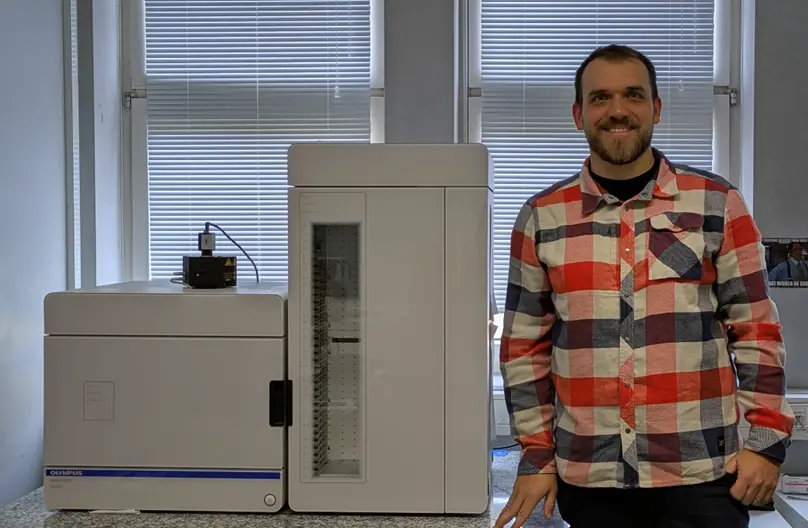
Dr. Georg Beythien works at the Department of Pathology of the University of Veterinary Medicine in Hanover, Germany. The department focuses on the pathology of infections and storage diseases of the respiratory tract and neural- and neuroendocrine systems of farm and companion animals. In this blog post, we share how the University of Veterinary Medicine in Hanover uses our SLIDEVIEW™ VS200 slide scanner to facilitate an understanding of animal pathologies.
Infectious Diseases in Animals and Humans
Infectious diseases pose significant health challenges for both farm and companion animals, impacting animal welfare, productivity, and public health. It has been estimated that 60 percent (more than two-thirds) of infectious diseases are transmitted between animals and humans. These diseases are called zoonoses and are estimated to cause one billion cases of illness in humans and millions of deaths per year.1 Several of these pathogens have only been identified in the past few decades, such as the avian influenza H1N1, severe acute respiratory syndrome coronavirus 2 (SARS-CoV-2), West Nile virus, Nipah virus, bovine spongiform encephalopathy (BSE), Ebola hemorrhagic fever, and human immunodeficiency virus (HIV).2
Effective disease management relies on early detection, vaccination programs, proper hygiene practices, and collaboration between veterinarians, farmers, and public health officials to prevent outbreaks and protect both animal populations and human communities.
Dr. Beythien’s Research on SARS-Cov-2 Infection in Hamsters
Since 2020, Dr. Beythien has focused his research on coronaviruses and their pathological effects in hamsters, mice, and other species. In 2022, Dr. Beythien and his colleague Dr. Federico Armondo published their research on viruses spread and associated pathology in the upper and lower respiratory tracts of Syrian golden hamsters after SARS-CoV-2 Omicron infection in comparison to Gamma, Delta, and ancestral strain infections in Nature Communications. Their results showed that the Omicron strain causes milder changes in the olfactory epithelium and minimal lesions in the lung compared to other strains. Therefore, this variant has a decreased pathogenicity in the upper and lower respiratory tract.3 Interestingly, the reduced pathogenicity of the Omicron variant in this animal model supports clinical observations of milder disease in humans.
The SARS-CoV-2 pandemic additionally highlighted the challenge posed by the emergence and rapid spread of novel viruses. In his publication in the International Journal of Molecular Sciences, Dr. Beythien and his colleagues evaluated whether double-stranded RNA (dsRNA) could serve as a marker for active SARS-CoV-2 replication in the lungs of infected Syrian golden hamsters. Their results showed that dsRNA detection is mainly confined to the early infection phases and corresponds to periods of high viral replication activity (Figure 1). The combined detection of dsRNA intermediates and viral antigens allowed a more comprehensive view of infection dynamics, bridging interpretative gaps between viral antigen levels and infectious titers at a single time point.4
Dr. Beythien’s work highlights the importance of animal models like the Syrian hamster for evaluating the virulence of emerging SARS-CoV-2 variants.
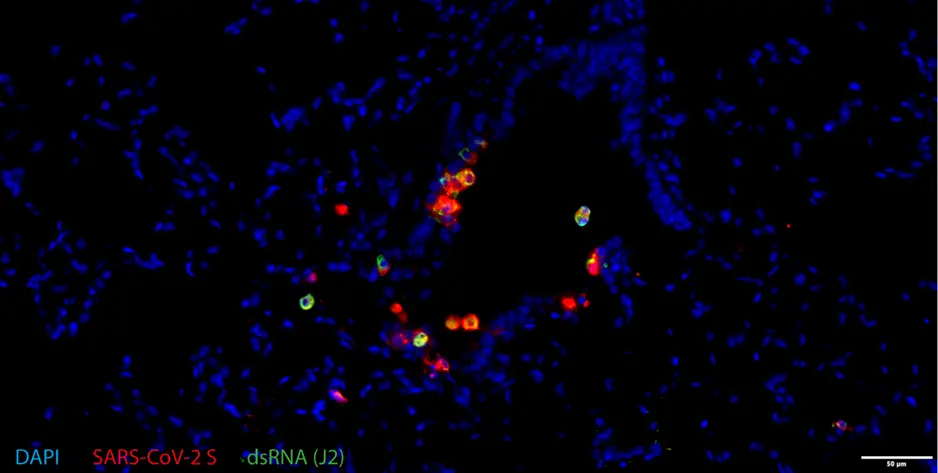
Figure 1. Double-stranded RNA (dsRNA, green) and SARS-CoV-2 spike protein (red) expression in hamsters infected with SARS-CoV-2 614G BavPat1 at four days post infection (dpi). Bar indicates 50 µm. Captured using the SLIDEVIEW VS200 slide scanner. Image courtesy of Dr. Georg Beythien.
Acquiring Quantifiable Results with an Advanced Slide Scanner
In December 2021, the Department of Pathology acquired the SLIDEVIEW VS200 slide scanner to digitalize slides for further analysis. Before this acquisition, Dr. Beythien mostly relied on semiquantitative slide assessment, and now almost everything is quantifiable.
Within the department, quantitative analysis now includes spatial assessment of cell counts, co-expression of proteins and mRNAs within cells and tissue sub-compartments, affected area measurements, and the assessment of cell morphology including glial cells within the central nervous system.
Dr. Beythien shared his impressions of the SLIDEVIEW VS200 slide scanner, highlighting the key role it plays throughout the department.
“The SLIDEVIEW VS200 slide scanner is central to many of our projects. It is used by the whole Department of Pathology, and we love the publication-quality images, ease of use, and the OlyVIA free image viewer software. When people come from other institutions to scan with our SLIDEVIEW VS200, they find the number of slides that can be added in the loader and scanned automatically, as well as the image quality, highly impressive.” — Dr. Georg Beythien
Dr. Beythien also remarked on the service and support, adding, “Evident’s customer service has always been very helpful and fast in their response.”
To learn more about the SLIDEVIEW VS200 slide scanner and how it can bring your research vision to life, reach out to us today for a demo.
A special thank you to Dr. Georg Beythien for his contributions to this story.
References
- Karesh, W. B., et al. 2012. “Ecology of Zoonoses: Natural and Unnatural Histories.” Lancet 380, no. 9857 (November 29): 1936–1945.
- Espinosa, R., D. Tago, and N. Treich. 2020. “Infectious Diseases and Meat Production.” Environmental & Resource Economics 76, no. 4 (August 4): 1019–1044.
- Armando, F., et al. 2022. “SARS-CoV-2 Omicron Variant Causes Mild Pathology in the Upper and Lower Respiratory Tract of Hamsters.” Nature Communications 13: 3519.
- Beythien, G., et al. 2024. “Detection of Double-Stranded RNA Intermediates During SARS-CoV-2 Infections of Syrian Golden Hamsters with Monoclonal Antibodies and Its Implications for Histopathological Evaluation of In Vivo Studies.” International Journal of Molecular Sciences 25, no. 21: 11425.
Disclaimer: The opinions and statements expressed in this interview are those of the individual researcher and do not necessarily reflect the views or claims of Evident. The products and technologies mentioned are intended for research use only and are not designed for clinical or diagnostic applications.