\Cancer is a major public health concern globally. In the 21st century, it has been responsible for almost one in six deaths.1 But not all news is bad: cancer mortality has been on the decline since 2023. This is mostly due to earlier detection, healthier lifestyle, and improved treatment.2
A key driver of these improved outcomes is the growing ability to tailor therapies to each patient’s unique tumor biology. Traditional treatments often rely on broad approaches that don’t account for individual variability, but modern precision oncology uses genetic, molecular, and functional profiling to identify the therapies most likely to work for each patient.
As tumors are highly complex and constantly evolving, having tools that can measure real-time drug response directly on patient-derived tumor samples is becoming increasingly essential. This shift toward personalized and functional treatment strategies represents one of the most promising advances in improving both clinical outcomes and quality of life for cancer patients.
Advancing Functional Precision Oncology with Automated 3D Microtumor Screening
Building on this progress, innovative technology platforms are emerging to translate these concepts into practical, scalable solutions. PreComb, a Swiss biotechnology company founded in 2018, is developing proprietary technologies to improve the success of oncology treatments by providing actionable, patient‑relevant drug‑response data early in cancer drug development and clinical decision‑making.
PreComb’s core technology, the 3DTwin® platform, is an automated, high-throughput system that uses patient-derived 3D microtumors to predict cancer treatment outcomes by capturing in vivo-like tumor behavior through longitudinal and clinically relevant drug testing. PreComb offers services to deliver standardized, longitudinal functional drug screenings in 3D cancer models, ranging from established cell lines to patient-derived tumors. The platform is designed to be placed on-site in hospitals or R&D departments, enabling real-time support for clinicians or cancer researchers.
Dr. Beckers, Head of Laboratory and Automation at PreComb, shares insights into the development and application of the company’s automated, high-throughput platform for functional precision oncology, including the role of 3D microtumor models and integrated incubation monitoring in advancing patient-specific cancer treatment strategies.
Dr. Beckers, what is your role at PreComb, and how are you involved in the development of the automated, high-throughput platform for cancer drug screening?
Dr. Beckers: I am the Head of Laboratory and Automation at PreComb, where I oversee our functional precision oncology drug screenings for clinical and pharmaceutical partners. In my day-to-day work, I develop patient-derived 3D microtumor models and make sure our fully automated 3DTwin® platform runs smoothly and reliably. This includes refining cell seeding and treatment conditions, building robust image acquisition workflows, and improving data processing.
Why did you choose to base your drug screening platform on 3D cell cultures rather than patient-derived adherent cell lines?
Dr. Beckers: 3D microtumors are physiologically more representative of solid tumors than cancer cells grown in 2D monolayers. For example, they consist of a proliferative outer rim, followed by a quiescent and hypoxic zone, and sometimes a necrotic core.
In many of our projects, we work directly with fresh tumor biopsies that contain not only cancer cells, but also immune and stromal components. To keep these distinct cellular compartments alive and interacting, it is essential to mimic the in vivo environment as closely as possible.
How will this platform support cancer treatment in the future?
Dr. Beckers: Our functional precision oncology platform can support oncologists by predicting which therapies are most likely to benefit a patient, before their treatment begins. By testing drugs directly on patient-derived tumor material, we generate individualized response profiles that can guide treatment selection.
For pharma partners, the platform offers an opportunity to evaluate new cancer therapies on clinically relevant patient samples early in development. It enables benchmarking against existing standards of care and supports data-driven candidate prioritization and indication selection. This ultimately helps deliver more effective treatments to patients, faster.
How does your platform compare to other available technologies?
Dr. Beckers: Our platform stands out in several ways:
To begin with, we generate long-term, dynamic insights by tracking how patient-derived 3D microtumors respond to treatment over time, rather than relying on a single endpoint measurement.
In addition, we test compounds at clinically relevant drug concentrations, enhancing translational predictivity.
Finally, our platform is designed to work directly with individual biopsy samples, allowing us to make personalized predictions without needing large patient cohorts.
Why did you choose to integrate the Evident CM30 incubation monitoring system into your platform, and what advantages does it offer compared to other available systems?
Dr. Beckers: After comparing several imaging options, we chose the Evident CM30 incubation monitoring system because it provides a fast, reliable, and cost‑effective way to monitor 3D microtumor growth within our automated workflow. The system delivers label‑free, quantitative imaging, allowing us to track treatment response without disturbing the cultures.
Moreover, its multipoint scanning capability allows efficient imaging of 384-well plates, supported by robust autofocus and adequate acquisition speed. In addition, the flexible API enables customization of acquisition parameters to suit our specific experimental requirements.
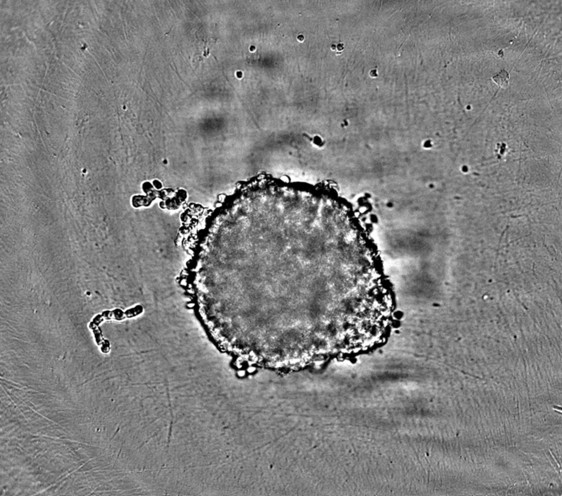
PreComb’s 3D microtumor generated from the HCT116 cell line.
What do you think is the future of automation and personalized medicine in cancer?
Dr. Beckers: I believe the future of automation and personalized cancer medicine lies in making functional drug screening accessible and scalable so it can become part of routine clinical decision‑making. To get there, workflows need to be simple, fast, and standardized so that high‑quality data can be generated directly at clinical sites.
In addition, this standardized functional data can be connected across sites, creating a collaborative data network that helps us learn from every patient. By combining automated workflows with shared datasets and AI‑guided analysis, we can accelerate research, help clinicians choose the most effective treatments for their patients, and support the pharma industry in prioritizing and developing high-need therapies.
References
1. Bray. F et al. 2024. “Global Cancer Statistics 2022: GLOBOCAN Estimates of Incidence and Mortality Worldwide for 36 Cancers in 185 Countries.” CA: A Cancer Journal for Clinicians. Volume 74, Issue 3.
2. Siegel. R et al. 2026. “Cancer Statistics 2026.” CA: A Cancer Journal for Clinicians. 13;76.
Related Content
Drug Efficacy Evaluation of 3D Cancer Spheroids Using an Imaging-Based Workflow
3 Ways Microscope Imaging Advances Organoid Research